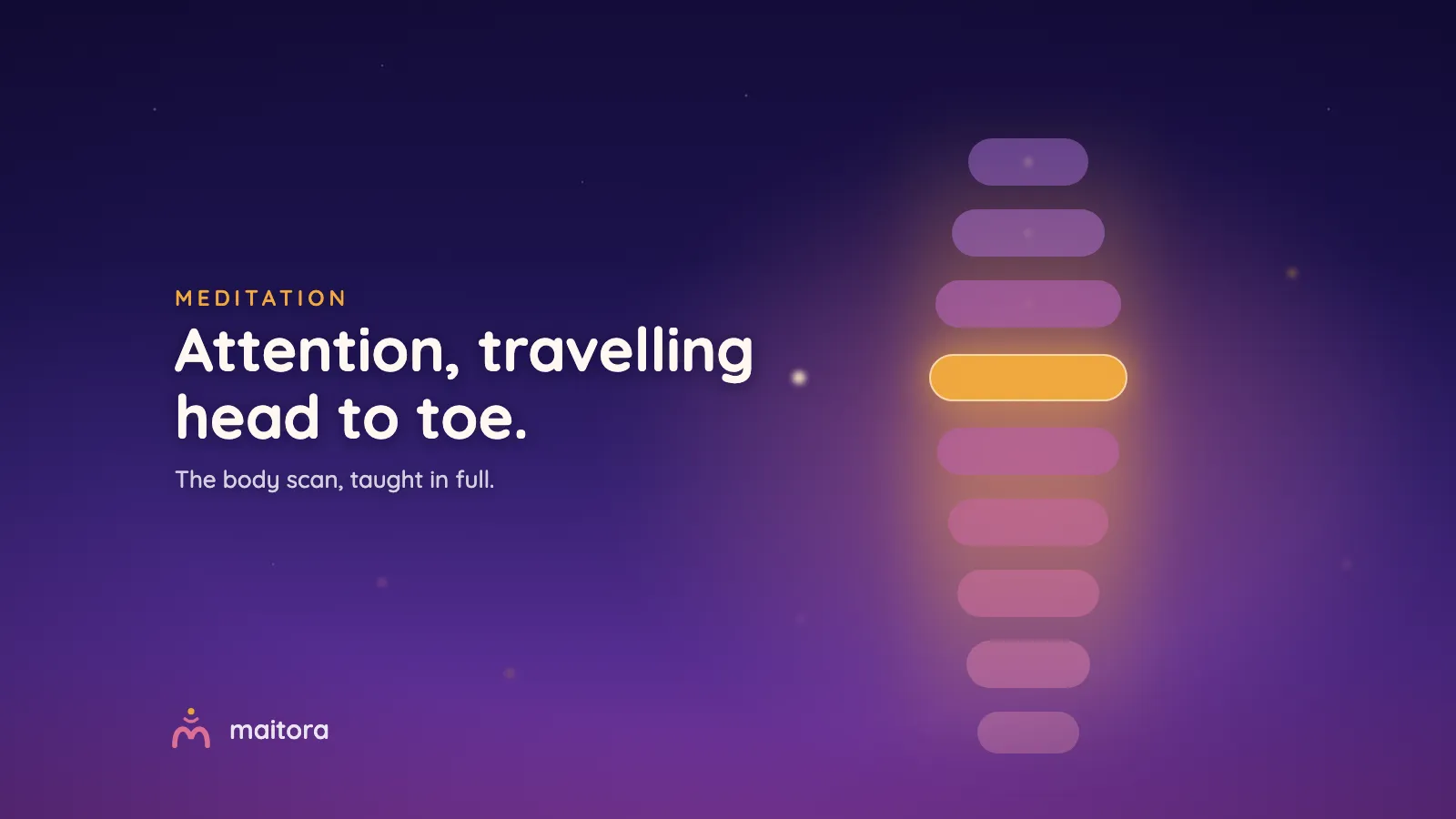
A body scan is a slow tour of your own body, taken with attention instead of judgement. You move awareness from the top of the head to the toes — or the other way — pausing at each region to feel whatever is actually there: warmth, pressure, tingling, nothing at all. That last one matters: you are not trying to relax each part, only to visit it. Relaxation, when it comes, arrives as a side effect of being noticed.
Why it works
Attention is nearly a single-channel instrument. Park it in the soles of your feet and there is very little bandwidth left for the argument you had at lunch — which is why the scan is such a reliable off-ramp from rumination. It also rebuilds a connection most of us run thin: hours can pass in a screen-lit day without one signal from the body making it through. The scan reopens that line, region by region, and people are often surprised by what was already there — a jaw held tight since morning, shoulders riding an inch high.
It's also one of the oldest formal practices in modern mindfulness teaching: an anchor of the eight-week stress-reduction courses that most of today's meditation research grew out of. A large 2014 review of that research by Goyal and colleagues found meditation programmes produced modest, real improvements in anxiety and low mood — with the honest footnote that studies rarely isolate the body scan from the courses it travels in. Encouraging, not miraculous; a practice, not a treatment.
A ten-minute script
- Lie down or sit — lying is traditional, sitting keeps you more awake. Let your hands rest anywhere. Two slow breaths to arrive.
- Start at the top of your head. Spend a few breaths just feeling the scalp, forehead, the small muscles around the eyes. Nothing to change.
- Move down slowly — jaw, neck, shoulders. If you find holding, you can soften it, but finding it is the actual exercise.
- Arms to fingertips, then chest and belly. Notice the breath moving things from the inside.
- Back, hips, legs, feet — a few unhurried breaths each, down to the toes.
- End with the whole body at once, held in one wide awareness, for the last minute.
Mind drifted off somewhere around the shoulders? Normal, every time. Rejoin the tour wherever you remember it — the returning, not the unbroken attention, is the skill being trained.
Falling asleep during it
Extremely common, and not a failure. If you're scanning at night and drift off by the knees, the practice did something useful. If you want to stay awake — the traditional aim — scan sitting up, earlier in the day, with eyes half open. And if deep rest while remaining awake is precisely what you're after, that has its own practice and its own guide: NSDR.
In Maitora
Body scan is one of the six shelves in Maitora's Guided Meditation practice — over a hundred hand-written sits across calm, sleep, focus, self-kindness, body scan and gratitude, each one walking you through slowly moving attention through the body, a region at a time. The narration voice ships inside the app and works with no signal at all, and nothing about your practice is collected — there's no account and no server. The script above is yours regardless; a voice just means you can close your eyes and be led.
Prefer to be led? Maitora is free to start on the App Store and Google Play.