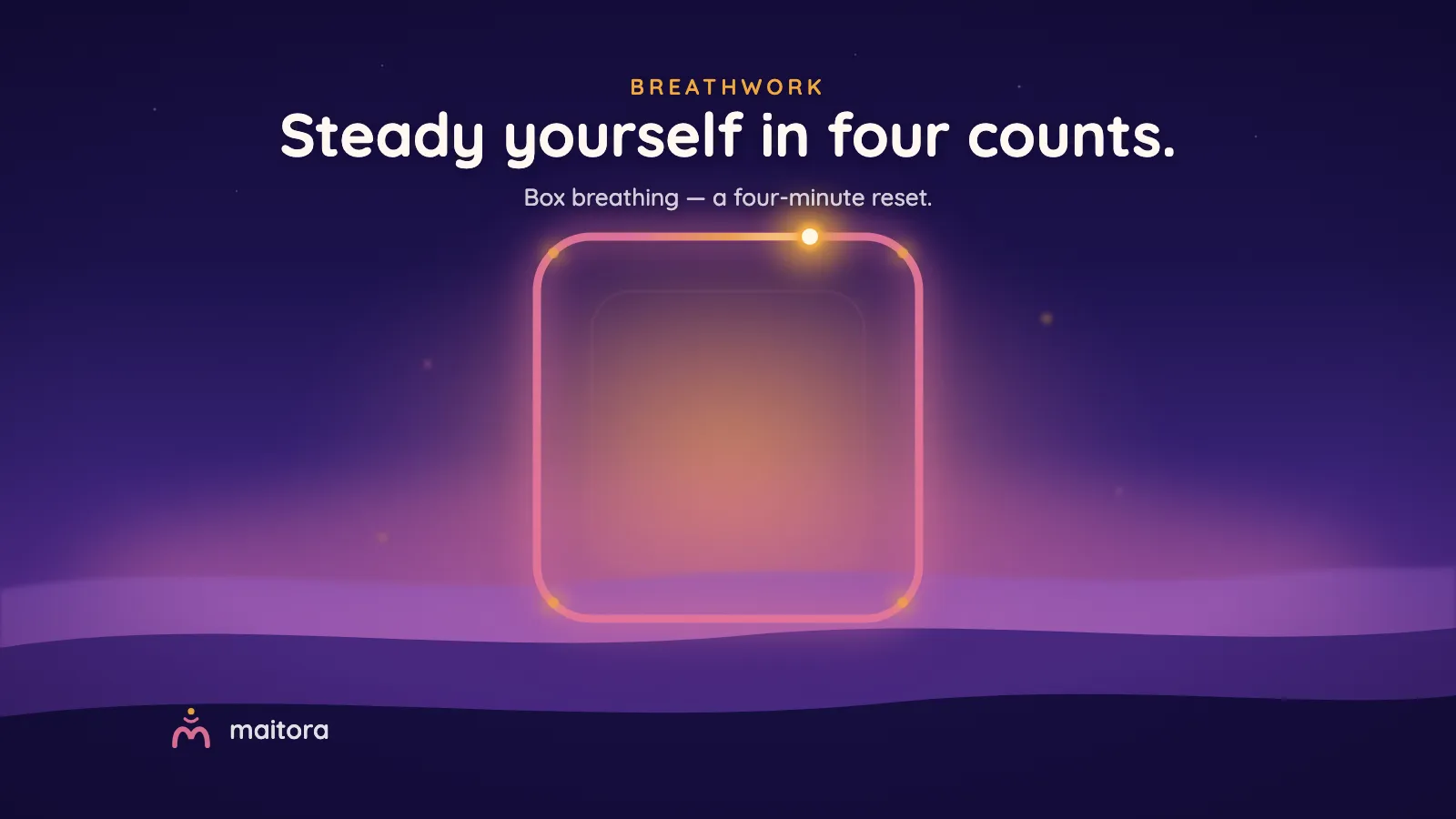
The whole technique fits in one sentence: breathe in for four counts, hold for four, breathe out for four, hold for four, and repeat. That square shape is the entire method — no equipment, no app required, nothing to believe in. It is taught to military pilots and paramedics as "tactical breathing" precisely because it works in the middle of a bad moment, standing up, eyes open.
The pattern
- Breathe in through the nose for a slow count of four. Let the breath go low — the belly moves before the chest.
- Hold for four. Soft hold, not a clenched one; shoulders stay down.
- Breathe out for four, through the nose or gently pursed lips. Unhurried — this is the part that does the calming.
- Hold empty for four. Notice the stillness at the bottom.
Trace the square with a fingertip on your knee if it helps — a side per phase. Counting and tracing give a racing mind a simple job, which is half the trick.
Why slow breathing calms a body
Breath is the one lever of the stress response you can steer directly. Slow, even breathing — and a long, unforced exhale in particular — nudges the nervous system towards its rest-and-settle mode: heart rate eases with the out-breath, and the body reads the rhythm as evidence that nothing is chasing it. A 2018 systematic review by Zaccaro and colleagues found slow-breathing techniques associated with increased parasympathetic activity and improved reported calm across the studies reviewed.
Honesty matters more to us than a sales pitch, so: the research on slow breathing is encouraging rather than miraculous. It reliably helps many people feel steadier within a few minutes. It is not a treatment for anything, and this article isn't medical advice — it's a technique, taught the way a friend would teach it.
A four-minute practice
- Sit or stand comfortably. Drop your shoulders once, on purpose.
- Breathe out fully to start from empty.
- Do four laps of the square — about a minute. If four counts feels like straining, use three. The square matters more than the size of it.
- Continue for four minutes, roughly fifteen laps. Mind wandered? That's not failing — noticing and returning to the count is the exercise.
- Finish by letting the breath go natural, and take one moment to notice any difference before you move on.
Good moments for it: before a difficult conversation, between meetings, in a parked car, in a queue, or lying awake at 3am — nobody around you can tell you're doing anything at all.
Troubleshooting, honestly
- Dizzy or short of breath? You're working too hard. Shrink to 3-3-3-3, or drop the holds entirely and just breathe out longer than you breathe in.
- Holds feel bad? Skip them. If you're pregnant, live with a respiratory or heart condition, or find breath-holds set off panic rather than settling it, use gentle paced breathing without holds instead — the slow exhale is doing most of the work anyway. When in doubt, ask a clinician who knows you.
- Counting feels mechanical? Good — mechanical is dependable at the moments when nothing else is.
In Maitora
Box is one of the four patterns in Maitora's Breathwork practice, alongside Resonant, 4-7-8 and Calming. A glowing orb paces the square for you, with gentle haptics on Apple Watch so you can follow it with your eyes closed — and like everything in the app, it runs entirely on your device and works in airplane mode. There's no account and nothing is collected; the technique above is yours either way.
Prefer to be paced? Maitora is free to start on the App Store and Google Play.