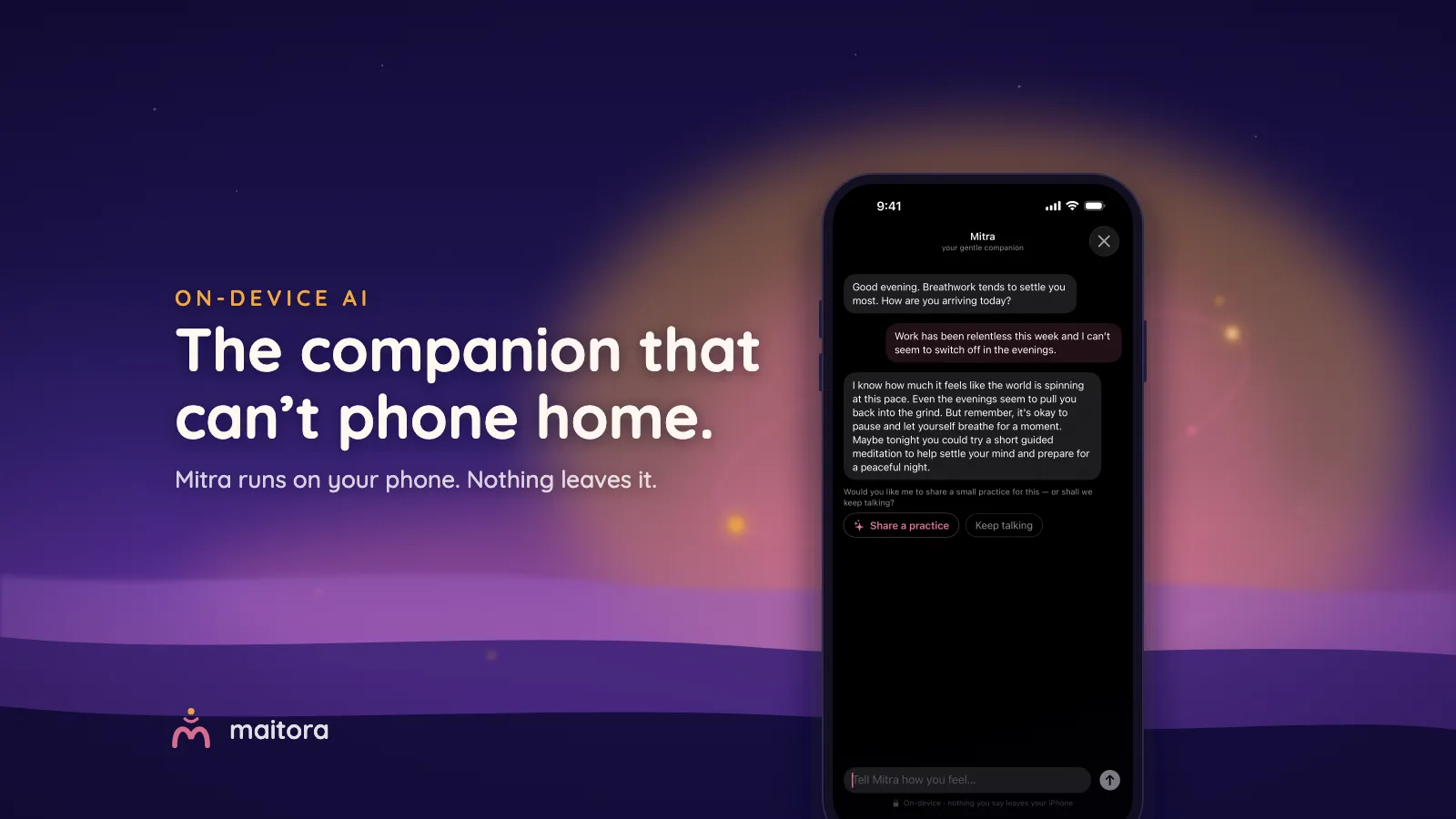
AI wellness companions are everywhere now, and the interesting question is not whether AI is good or bad for mindfulness. It's a quieter, more practical one: where does the thinking happen? On a server somewhere, or on the phone in your hand? For most software the answer barely matters. For an app you tell how you actually feel at 2am, it changes everything.
Two architectures, plainly
Cloud AI is what most apps use. You type something; your words travel to a data centre; a large model composes a reply; the reply travels back. This is a reasonable design — it's how the most capable models run, and the companies involved usually describe how long your words are kept and who can see them. But structurally, the words leave. What happens to them afterwards is a matter of policy, and policies are written by people and changed by people.
On-device AI flips the geometry. A smaller model lives in the app on your phone and does its thinking on the phone's own chip. Your words never travel anywhere, so there is no policy to trust about what happens to them elsewhere — there is no elsewhere. The proof is refreshingly physical: switch on airplane mode, and an on-device companion keeps working, because nothing it needs is on the other side of a network.
Why this matters more for a meditation app
Consider what a wellness companion actually hears. Not search queries — confessions. "I can't switch off." "I snapped at the kids again." "I'm dreading tomorrow." This is intimate by nature, and it's exactly the kind of data researchers keep finding handled carelessly in this category.
With a cloud companion, the honest answer to "who could ever read this?" is a list: the company, its processors, anyone a breach exposes it to, and — depending on the policy — the training pipeline of a future model. With an on-device companion, the honest answer is one word: nobody. Not as a promise. As a property of the architecture.
The honest trade-offs
On-device models are smaller than the giants in the data centres, and it would be marketing nonsense to pretend otherwise. An on-device companion won't write you an essay on Stoic philosophy. It also needs a reasonably modern chip, so availability can differ between devices and platforms. What a small, close model does beautifully is the job a mindfulness companion actually has: listen kindly, reflect back, and suggest one small next step. That job doesn't need a supercomputer. It needs trustworthiness and presence.
How Mitra works
We make Maitora, so here is our own design, stated plainly enough to be checked. Mitra — Sanskrit for friend — is the companion in Maitora. On iPhone, iPad and Mac it's powered by Apple Intelligence, running on the device: it asks how you're arriving, reflects what it hears, suggests a practice that might help, and can write a fresh guided meditation or a sleep story for your evening. Nothing you say to it leaves your phone. It's a companion, not a therapist — if it senses you may be in crisis, it steps back and points to real human help.
On Android, Maitora ships without Mitra — deliberately. Rather than dress up a cloud service or a canned script as a companion, we leave it out until it can be the real thing on that platform too. Every Android user still gets the full guidance library: over 1,300 hand-written meditations and sleep stories, bundled inside the app, read aloud by a narration voice that also runs entirely on the device. Honesty about a platform gap beats a fake feature — that's the same principle as the privacy design, applied to product decisions.
How to check any "AI" app for yourself
- The airplane-mode test. If the AI feature stops working offline, the thinking happens elsewhere — which is fine, as long as the app is honest about it.
- Read the privacy label on the App Store or Play listing (our two-minute guide shows exactly where to look).
- Search the privacy policy for "train". The sentence that says whether your conversations improve someone's future model is the sentence worth finding.
- Notice what the app claims it can do. A companion that promises therapy is over-promising, whatever its architecture. Good tools know their size.
Try the test on Maitora. Install it from the App Store or Google Play, switch on airplane mode, and use it — every practice, the narration, and Mitra where it's available. That's the whole argument, demonstrated.