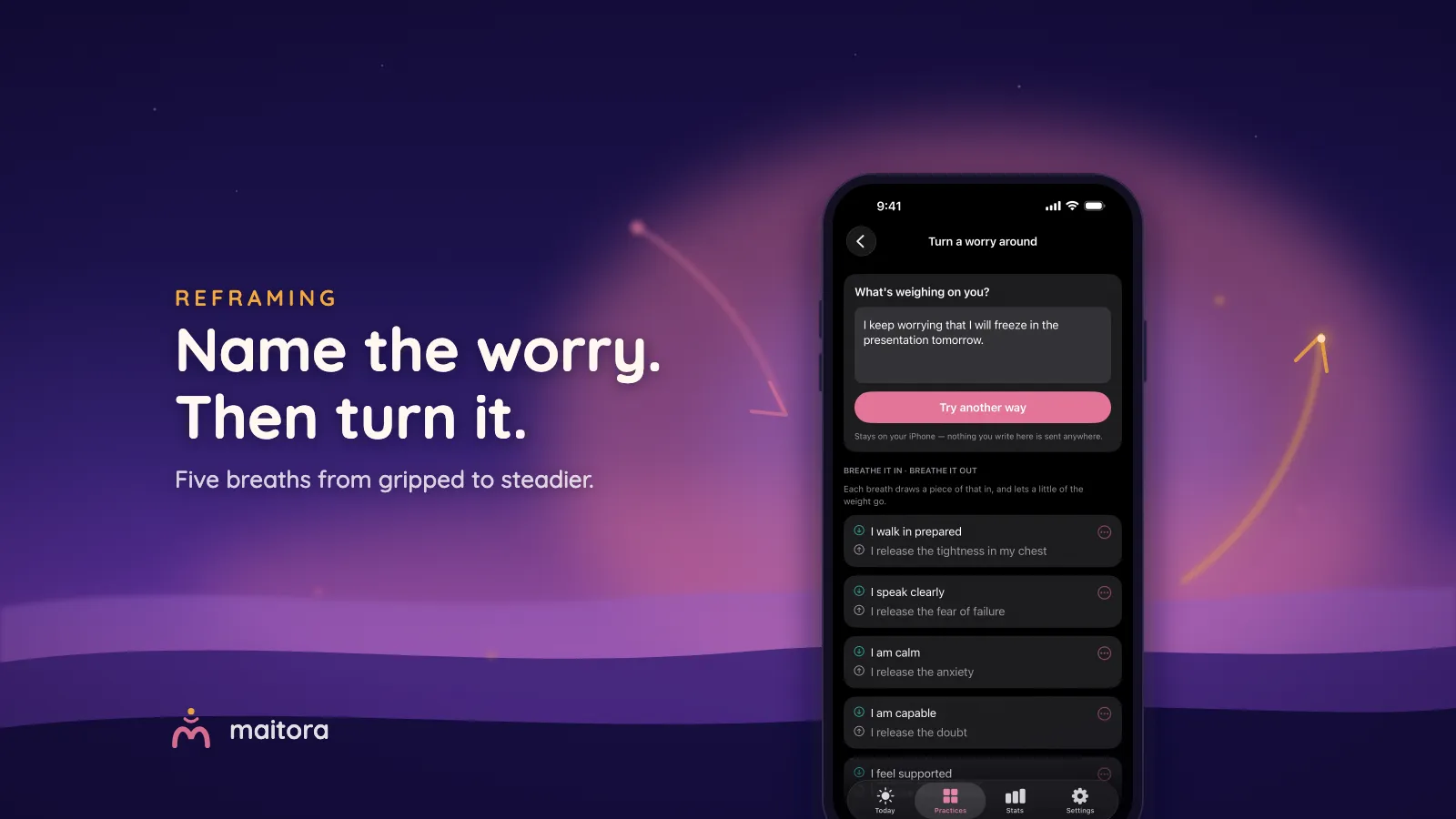
An anxious thought does most of its damage while it stays vague — a weather system circling just out of sight, felt everywhere and located nowhere. Reframing is the old, well-studied move against it: catch the thought, write it down in one honest sentence, and then turn it — not into a pep talk, but into something equally true that leaves you more able to act. Three steps. None of them require believing anything you don't.
Step one — name it
Write the worry as one specific sentence, in your own words: "I keep worrying that I will freeze in the presentation tomorrow." Not "work stress", not "I'm spiralling" — the actual thought, with its actual subject. Two things happen at once. The fog becomes an object: a sentence has edges, and a thing with edges is a thing you can work with. And putting a feeling into words tends to turn its volume down a notch by itself — naming engages the deliberate mind, and the deliberate mind runs cooler than the alarmed one.
Step two — turn it
Now write a second sentence that is also true and more useful to hold. Not the opposite — the turn. "I will freeze" doesn't become "I will be brilliant"; it becomes "I've prepared, and I can pause and recover if I lose my place." The test is the same one we use for writing affirmations: you must be able to say the new line without flinching. A reframe you don't believe is just the worry wearing a costume.
This move — reappraisal, in the research literature — is one of the best-studied habits in emotion science. Gross and John found that people who habitually reinterpret situations rather than suppressing how they feel report more positive emotion, fewer low moods and closer relationships. The honest footnotes: much of that evidence is correlational, and reframing is a skill — the first attempts feel wooden, the fortieth doesn't. It's practice, not a switch, and none of this is medical advice.
Step three — breathe with it
A reframe that stays on paper is an idea; paired with breath, it starts to land in the body, where the worry actually lives. Take the two sentences you now have and give each a direction: the steadying line rides the in-breath, the gripping one leaves on the out-breath.
- Breathe in slowly — I've prepared for this.
- Breathe out longer — I release the rehearsing.
- Repeat for five slow breaths, the exhale always a little longer than the inhale.
Five breaths won't delete a worry, and they're not supposed to. What they reliably do is return you to the room — from the imagined Tuesday to the actual evening — with the turned sentence closer to hand than the original.
When reframing isn't the tool
Some thoughts shouldn't be turned. A real danger needs action, not reappraisal; grief needs company, not corrections; and on some days the honest move is simply naming — this is fear, and I can be with it — without asking the sentence to improve. If the same worry returns every night, or anxiety has started shaping what you avoid and how you sleep, that's beyond what a technique should carry, and talking to a professional is the strong move, not the last resort.
If you're in crisis right now, please reach for people, not apps — ours included. findahelpline.com lists free, confidential helplines worldwide. In the US, call or text 988. In the UK, Samaritans are at 116 123. In India, Tele-MANAS is at 14416.
In Maitora
On iPhones and iPads with Apple Intelligence, Maitora opens a ninth practice built on exactly these steps: Turnaround. You write what's weighing on you, and it comes back as something you can breathe with — five paired breaths, each with a line to draw in and a line to let go, written for the worry you actually named. It runs entirely on the device: nothing you write is sent anywhere, and anything that reads as crisis is met with support resources rather than a practice. On every other device the three steps above work the way they always have — with a pen, which asks no permissions at all.
Five breaths from here. Maitora is free to start on the App Store and Google Play.