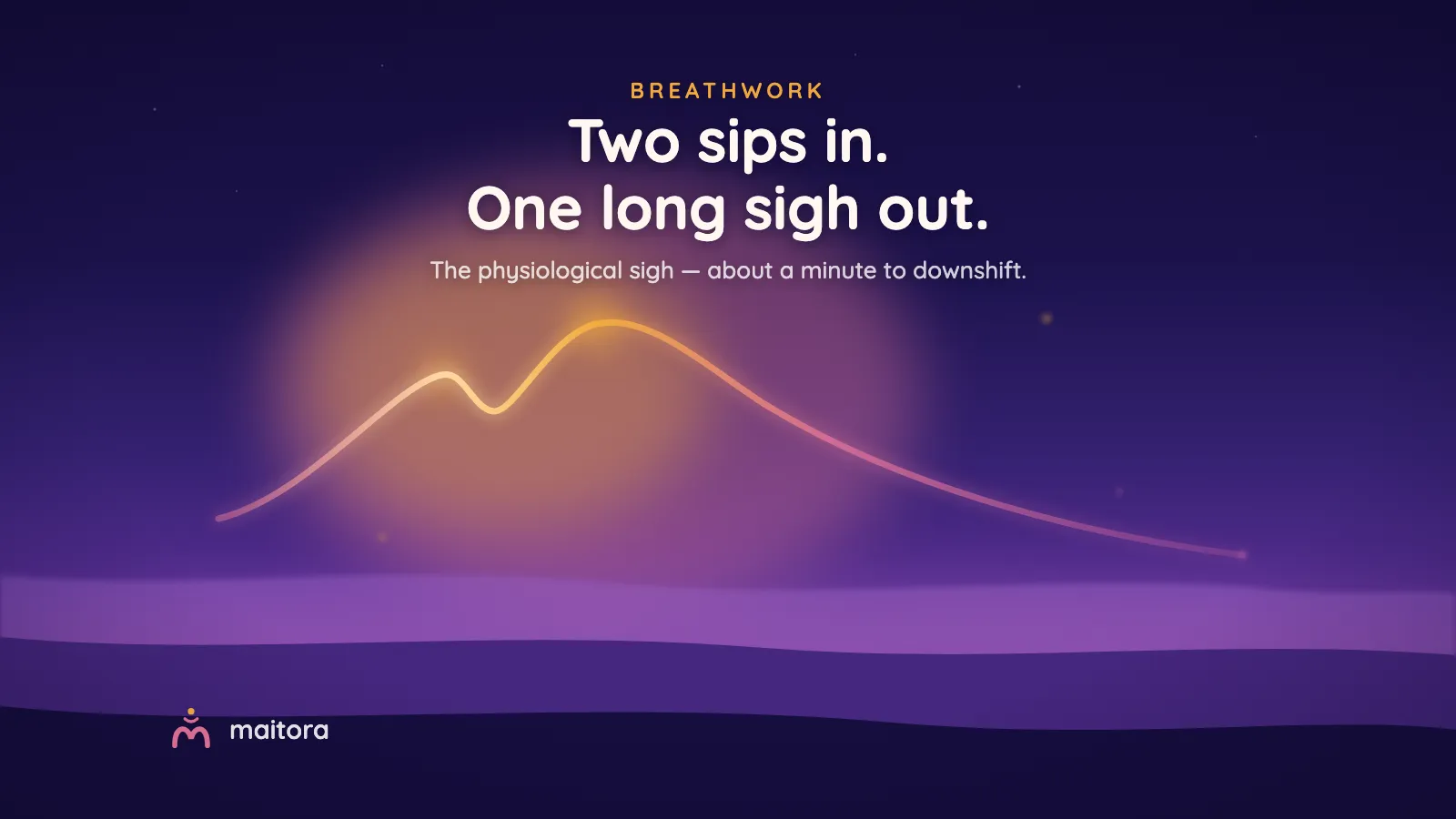
Your body already knows this one. Watch someone settle after crying, or a child coming down from a sob: two quick breaths in, then one long breath out. That double-inhale-and-sigh is the physiological sigh — the reset the body performs on its own every few minutes, without being asked. The technique is simply doing it on purpose. It takes about six seconds, works standing up with your eyes open, and nobody around you will notice a thing.
The move
- Breathe in through the nose — an ordinary, unforced inhale.
- Without breathing out, sip in a second, shorter inhale on top of the first. This is the signature of the technique — a quick top-up that fills the last corners of the lungs.
- Exhale long and slow through the mouth, until you're comfortably empty. Let it be audible if you like; a sigh is allowed to sound like one.
That's one sigh. In a tense moment, one to three of them is the dose — then let the breath go back to normal and see where you are.
Why the double inhale
The little top-up breath isn't a flourish. Under stress — and during ordinary shallow breathing — some of the lungs' millions of tiny air sacs deflate and stick, like wet balloons. The second inhale pops them open again, briefly giving the lungs more working surface to offload carbon dioxide, and the long exhale then does what long exhales do: eases the heart rate down and leans the nervous system towards its rest-and-settle side. It's the rare relaxation technique with a mechanical story this concrete — which is probably why the body ships it as a built-in reflex.
The study, actually read
The sigh had a moment in the press a few years ago, so it's worth citing the actual paper rather than the headlines. In a 2023 randomised trial from Stanford, 108 adults spent five minutes a day for a month on one of four assignments: mindfulness meditation or one of three breathing exercises. Everyone improved. The cyclic-sighing group — repeated physiological sighs for the full five minutes — improved most on daily mood measures and was the only group whose resting breathing rate measurably slowed.
The honest print: it was a remote study, the outcomes were largely self-reported, and 108 people for one month is a promising trial, not a settled science. The headline "better than meditation" oversold a modest gap between things that both helped — and a five-minute breathing drill and a meditation practice are after different goods anyway. Our reading: the sigh earned its reputation as an in-the-moment tool, and meditation was never competing for that job.
Using it
- In the moment, use one to three. Before you open the difficult email. After the phone call. In the hallway between the meeting that went badly and the one that hasn't started. The sigh's whole advantage is that it needs no posture, no privacy and no run-up.
- As a daily practice, sigh cyclically. Five minutes of repeated sighs — the trial's protocol — done at the same time each day. It pairs naturally with an existing anchor: after coffee, before the commute.
- Stack it. A sigh is a good first move before slower work: one sigh, then a few laps of box breathing or 4-7-8 if you have the minutes.
- If it makes you lightheaded, make the inhales smaller and the pace lazier — and as with any breathwork, if you live with a respiratory or heart condition, ask a clinician who knows you.
In Maitora
We'll be honest: you don't need an app for a sigh — ours included. The body ships this one free. Where Maitora helps is with the practice version: the Breathwork orb paces slow, exhale-weighted patterns so five minutes actually lasts five minutes, with haptics on Apple Watch and everything running on your device, offline, with no account. The reflex is yours; we just help you show up for it daily.
Five paced minutes a day. Maitora is free to start on the App Store and Google Play.