You cannot argue a racing mind into sleep. Trying is the classic trap: the harder you chase sleep, the further it moves. What a racing mind can be is gently occupied — given something to hold that asks nothing of it. That is the entire job of a sleep story, and it's why being read to worked when you were small, and still does.
What's actually keeping you awake
For most people it isn't noise or caffeine — it's the planning-and-replaying loop. The lights go out, the day's inputs stop, and the narrative mind seizes the empty channel: tomorrow's meeting, that thing you said in 2019, a budget, an argument. Sleep researchers call this pre-sleep cognitive arousal, and it's one of the most common threads in ordinary insomnia. The loop feels involuntary because it mostly is; willpower makes a poor off-switch.
Why a story helps
A slow story works by displacement, not magic. It hands the narrative mind a narrative — one with no stakes, no decisions, and nothing to rehearse. Attention drapes itself over the tale, the planning loop loses its channel, and arousal drifts down until sleep can do what it was trying to do all along. The story doesn't put you to sleep; it stops you keeping yourself awake.
This is also why good sleep stories are deliberately a little dull. Plot is counterproductive. You want a slow walk through a quiet place, described at the pace of breathing.
Using one well
- Start it at lights-out, not before — it belongs to the drifting, not the scrolling.
- Volume low, screen face-down or off. The voice should sit at the edge of attention.
- Don't try to finish it. A sleep story is designed to be lost. Falling asleep at minute four is the story succeeding.
- Repetition is fine. Novelty isn't the point; familiarity soothes. The same story for a week is a lullaby, not a rut.
- Mind still racing at the end? Let another begin, or pair it with a few slow exhales first — a couple of breathing laps lower the idle before the story takes over.
The quiet supporting cast still matters: a consistent wake time, a dim final hour, and a bedroom that isn't also your inbox will do more than any single technique.
In Maitora
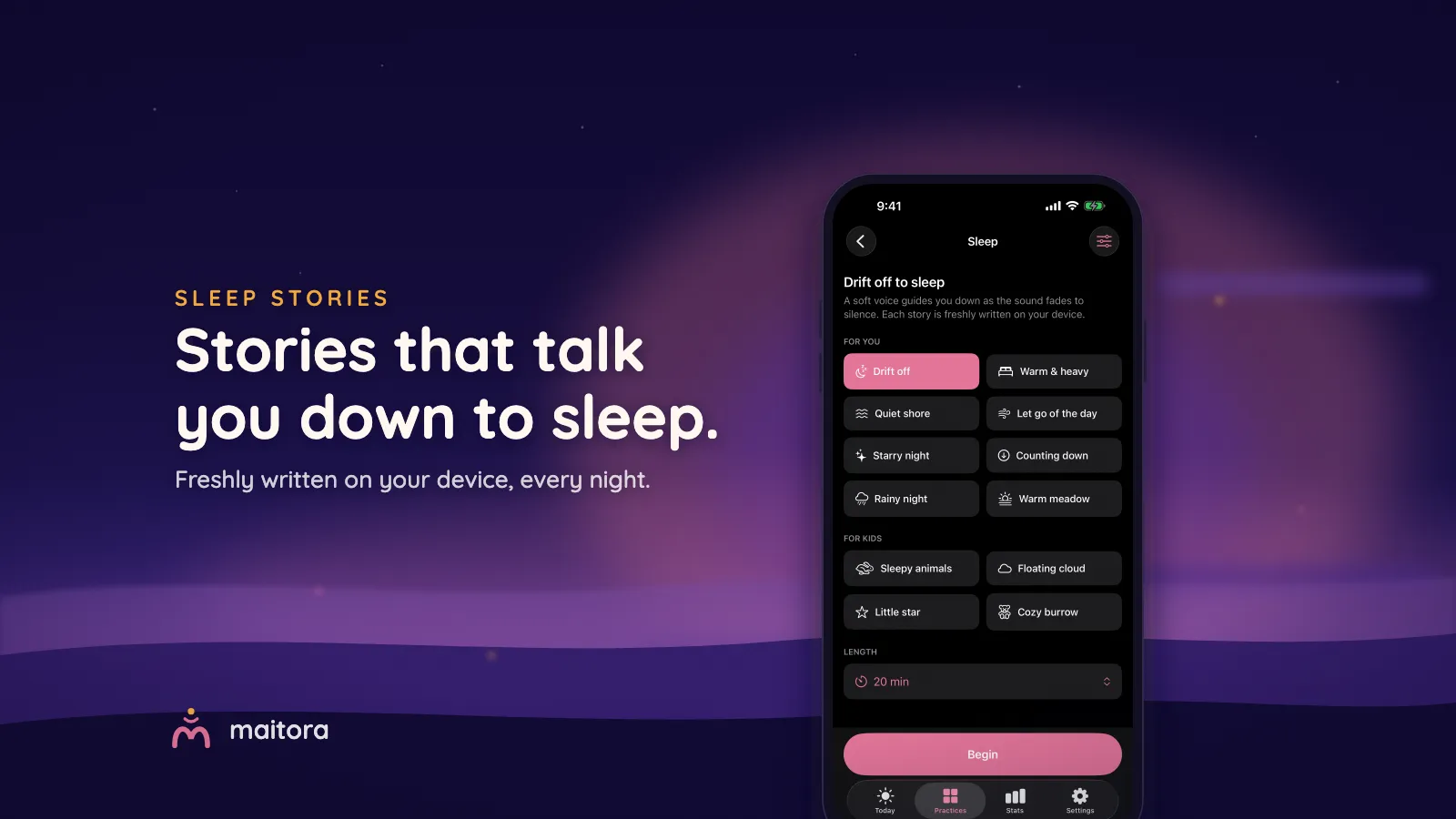
We make Maitora, and its Sleep Stories are built around one detail we care about: they fade to silence as you drift off, and no bell rings at the end — nothing wakes you to tell you the audio finished. The stories come from the same hand-written library as the guided sits, narrated on your device by a voice that ships inside the app. Everything works in airplane mode — so the phone on your nightstand can spend the whole night with its radios off, which is its own kind of sleep hygiene.
Tonight, then. Maitora is free to start on the App Store and Google Play.