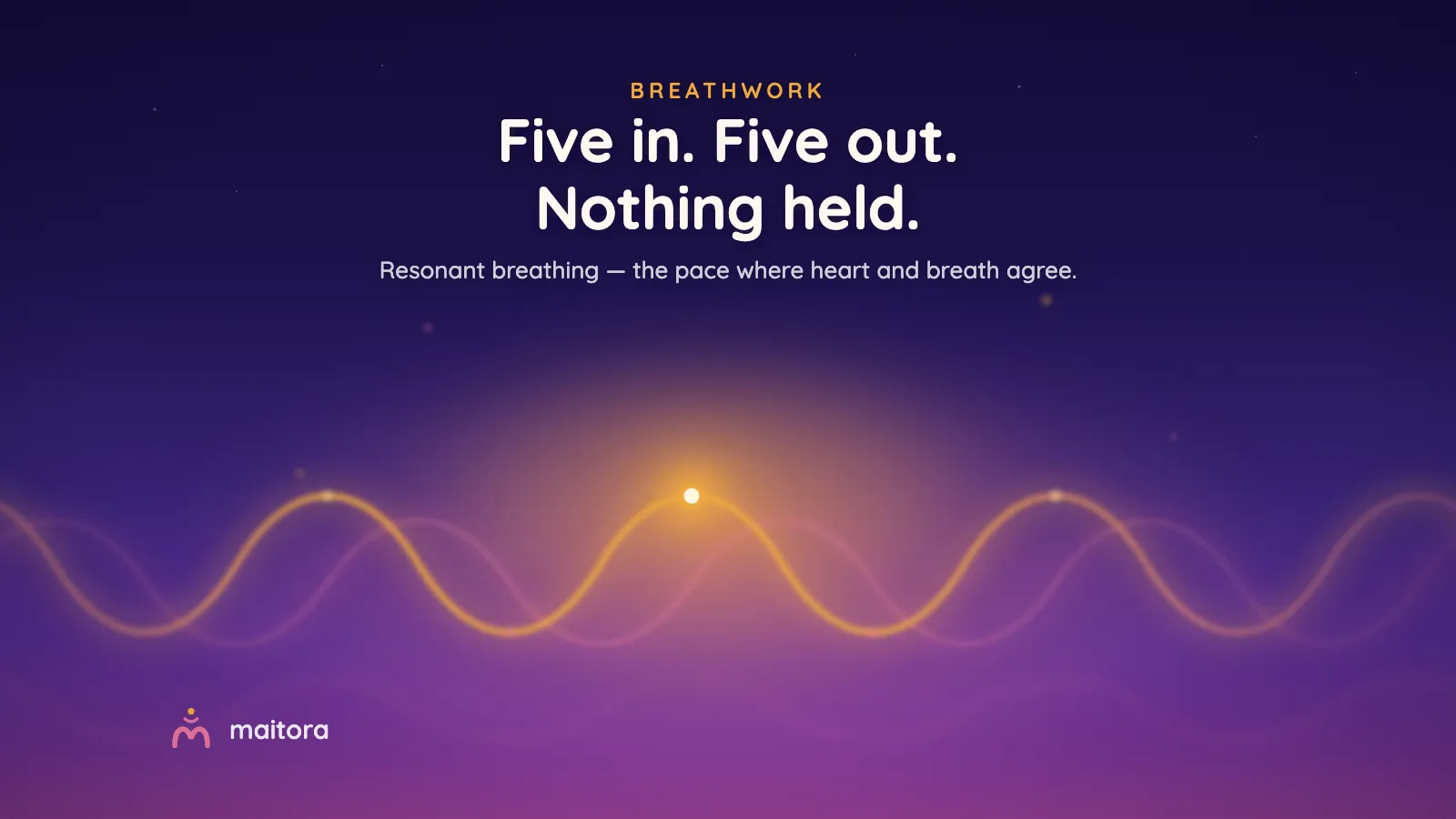
This one has no corners and no holds: breathe in for five counts, breathe out for five, and repeat. That is the entire technique. Ten seconds a breath, six breaths a minute — a pace slow enough to feel almost indulgent, and the one that decades of heart-rate research keeps circling back to. Where box breathing is a reset for a bad moment, resonant breathing is a pace you can live at for a while: five minutes, twenty, a whole commute.
The pattern
- Breathe in through the nose for a slow count of five. Low and unhurried — the belly rises before the chest does.
- Breathe out for five, through the nose or softly pursed lips. No push at the end; let the last count empty on its own.
- Repeat. No holds anywhere — the breath turns at the top and bottom like a swimmer turning at the wall, smooth and continuous.
If five counts feels like stretching, start at four in, four out and lengthen over a week or two. The evenness matters more than the number: in and out the same length, wave after wave.
Why six breaths a minute, specifically
Your heart doesn't beat at one fixed speed — it quickens slightly as you breathe in and eases as you breathe out. Breathe at around five to six breaths a minute and that natural swing gets unusually large: heart, breath and blood pressure start moving together, in something close to rhythm. Researchers call the pace at which the swing peaks your resonance frequency, which is where the technique's name comes from — and a larger swing is broadly read as the nervous system's rest-and-settle side having more say. A detailed review by Lehrer and Gevirtz lays out why breathing at this pace is the core of heart-rate variability training, and why the calm it produces tends to be felt within minutes.
Honesty, as ever: the precise resonance pace differs slightly from person to person (roughly 4.5 to 7 breaths a minute), and much of the research is on longer training courses rather than single sessions. You don't need a lab to benefit — five-in, five-out lands close enough for almost everyone — but this is a practice, not a prescription, and none of it is medical advice.
A five-minute practice
- Sit comfortably, both feet down, and let your shoulders drop once, deliberately.
- Breathe out fully to begin from empty.
- Settle into five in, five out. Count the first minute or two; after that the rhythm mostly carries itself.
- When the mind wanders — it will — come back to the count without a verdict. The returning is the practice.
- After five minutes, let the breath go back to its own pace and notice what changed: jaw, shoulders, the speed of your thoughts.
Because there's nothing to hold and nothing to strain, this is the pattern that suits long stretches — background breathing for a train ride, a slow walk, or the ten minutes before something that matters.
Resonant, box, or 4-7-8?
- Resonant (5-5) — for balance and steady calm you can sustain. The gentlest of the three; the one to live at.
- Box (4-4-4-4) — for sharp moments. The corners and holds give a racing mind a job.
- 4-7-8 — for winding down towards sleep. The long exhale does the heavy lifting.
There's no wrong door. Pick whichever your day calls for; they're all the same lever — slow, deliberate breath — held at different angles.
In Maitora
Resonant is the pattern Maitora's Breathwork practice opens with, and it's free on every device, alongside Box. A glowing orb swells and settles at the five-and-five pace so you're following a shape rather than counting, with gentle haptics on Apple Watch for eyes-closed practice. Like everything in the app it runs entirely on your device and works in airplane mode — and the technique above is yours either way, no app required.
Prefer to be paced? Maitora is free to start on the App Store and Google Play.
More from Learn
Box breathing: a four-minute reset →
The physiological sigh →
All guides →